
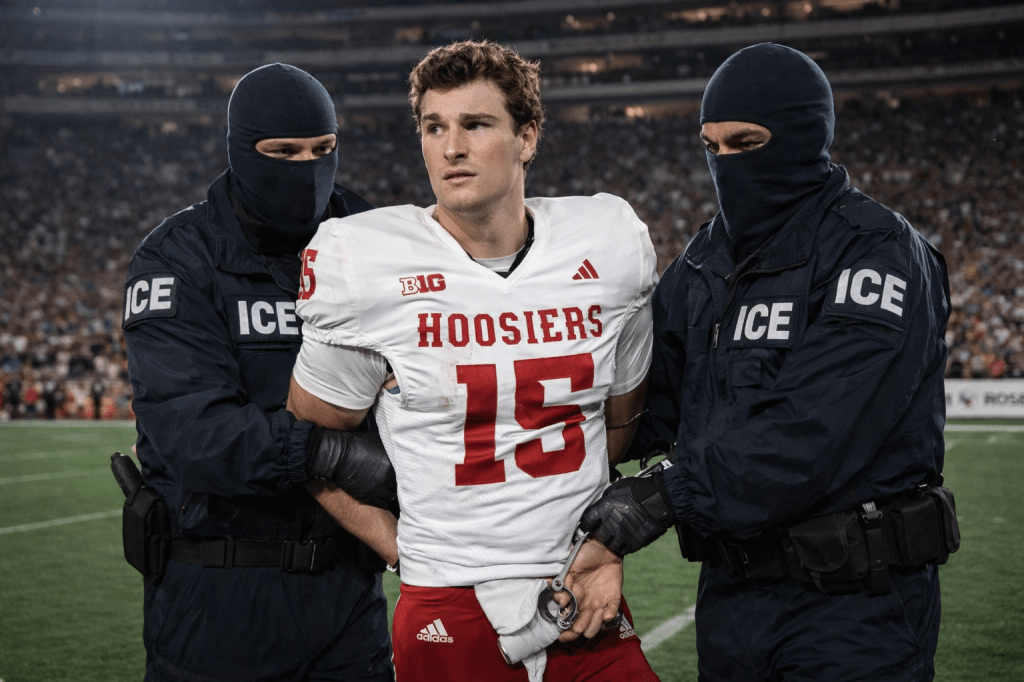
PASADENA, CA — The Rose Bowl fell silent after Immigration and Customs Enforcement agents entered the field mid-drive and detained Indiana quarterback Fernando Mendoza, an American citizen, in what officials described as a routine, precautionary, patriotic enforcement action.
The stoppage occurred without warning. No flags were thrown. No announcement was made. Agents simply walked past referees, television crews, and confused linemen, approached Mendoza on the sideline, and asked him to place his helmet on the ground “until we sort some things out.”
Within seconds, the largest stage in college football had become an administrative holding area.
“We are operating under reasonable suspicion framework,” said ICE spokesperson Daniel Kress, speaking near the end zone. “The suspicion being that he looked… not from here.”
When asked to clarify, Kress gestured broadly.
“You know. Name. Parents. Skin tone. Composure. Accent neutrality. These things raise questions.”
Mendoza reportedly complied without protest, producing his U.S. passport, Indiana driver’s license, student ID, and a laminated copy of his birth certificate his mother had insisted he carry “just in case.”
Agents continued to detain him.
“Documentation doesn’t resolve identity anymore,” one agent explained. “It complicates it.”
Officials confirmed Mendoza was not under arrest, but also not free to leave.
“This is not a detention,” Kress said. “It’s a pause on freedom while we verify Americanness.”
Referees initially attempted to resume play but stopped after realizing the quarterback was still being questioned near the 40-yard line. Broadcasters cut to commercial as producers scrambled to determine whether this fell under NCAA rules or federal supremacy.
“We don’t have a protocol for this,” said one official. “There’s nothing in the rulebook about citizenship challenges.”
As the delay stretched past ten minutes, ICE agents questioned Mendoza about his parents’ immigration timeline, his grandparents’ political beliefs, and whether he had ever “felt more Cuban than American on a given day.”
“I just play football,” Mendoza said quietly.
Agents reportedly took notes.
In the stands, confusion turned to unease.
“I thought this was about border security,” said one fan.
Another asked whether season tickets now required proof of citizenship.
ICE officials confirmed that the action was part of a broader initiative aimed at “restoring confidence through visibility.”
“People need to see enforcement happening,” Kress said. “Anywhere. Everywhere. Especially places you thought were safe.”
When asked why an American citizen was detained during a nationally televised game, Kress shrugged.
“Mistakes are possible when you detain first and verify later.”
After approximately 19 minutes, Mendoza was released without explanation, apology, or paperwork, just a brief reminder to “keep your documents handy.”
Play resumed as if nothing had happened.
Mendoza returned to the huddle visibly shaken, completing a short pass on the next snap before glancing briefly toward the tunnel, as if checking whether it was still open.
ICE later issued a statement clarifying that the agency “reserves the right to temporarily restrict movement of any individual whose citizenship raises questions,” adding that citizenship itself remains “a fluid concept under active review.”
The game continued.
The precedent did, too.





 Limestone Ledger
Leave a comment